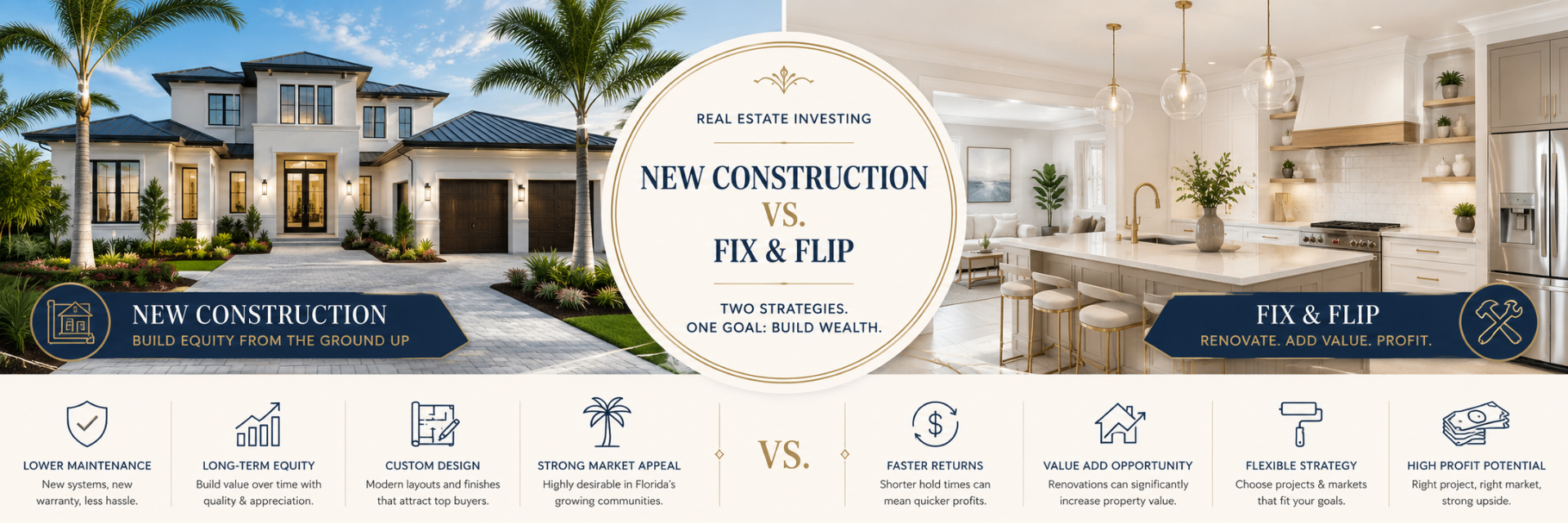
New Construction vs. Fix & Flip: Which Model Fits Your Investment Goals?
Both strategies have built fortunes in Florida real estate. But they reward very different skill sets, timelines, and risk tolerances. Before you commit capital, understand exactly what each model demands — and what it delivers.
Two investors walk into the Florida market with the same $350,000. One buys a distressed property in a transitional neighborhood, renovates it in 90 days, and hopes to sell at a profit. The other acquires a vacant lot, builds a brand-new 3-bedroom home to spec, and exits 10 months later. Both are executing proven real estate strategies. But from there, almost everything is different — the risks, the returns, the execution requirements, and the investor profile each strategy actually suits.
The Fix & Flip Model: Speed, Skill, and Spread
Fix & flip investing is straightforward in concept: buy an underpriced or distressed property, renovate it efficiently, and sell it above your total cost basis. The profit margin — the "spread" — is your return. In practice, however, this model rewards a very specific type of operator.
The fix & flip investor wins on speed and execution. Holding costs accumulate daily: mortgage interest, insurance, property taxes, and utilities don't pause while contractors work. A renovation that runs 30 days over schedule can quietly erase 20–30% of the projected margin. This is why experienced flippers have deep contractor relationships, pre-negotiated supply chains, and the ability to make rapid design decisions without second-guessing.
The acquisition phase is equally demanding. In competitive markets, the best distressed properties are identified and under contract before they hit the MLS. Successful flippers build pipelines through wholesalers, probate attorneys, direct mail campaigns, and driving neighborhoods. For investors operating remotely — including international capital partners — replicating this pipeline is extremely difficult without an established local team.
The New Construction Model: Process, Patience, and Predictability
New construction investing operates on a fundamentally different logic. Instead of buying a problem (a distressed property) and solving it quickly, you are building an asset from the ground up — controlling every variable from location and floor plan to finish quality and market timing.
The advantages of building new are structural, not circumstantial. A newly completed home requires no deferred maintenance disclosure, carries full builder warranty protections, and enters the market with the marketing advantage of being the newest product available in its price range. In Florida's 2025–2026 market, where buyers are increasingly scrutinizing older homes for insurance complications and HOA assessments, this positioning is commercially significant.
"New construction in Florida benefits from a structural market bias: buyers pay premiums for warranty protection, energy efficiency, and the absence of hidden renovation surprises — all of which a freshly built home delivers by default."
Construction timelines are longer than a typical renovation, typically running 8 to 12 months from land acquisition to closing. But the cash flow structure is fundamentally different: capital is disbursed in milestone-linked tranches rather than all at once, preserving liquidity and giving investors checkpoints at each stage. The process is also highly trackable — modern construction management platforms provide real-time visibility into progress, photos, and cost burn.
Side by Side: The Key Differences
| Factor | New Construction | Fix & Flip |
|---|---|---|
| Timeline | 8–12 months | 3–6 months |
| Capital Deployment | Phased (milestone-based) | Front-loaded at acquisition |
| Primary Risk | Permit delays, material costs, market shift at delivery | Renovation overruns, hidden defects, mispriced acquisition |
| Local Expertise Required | Moderate — managed by builder | High — critical for acquisition & rehab |
| Remote Investor Suitability | High — structured process, transparent tracking | Low — requires constant local oversight |
| Product Condition at Sale | Brand new, full warranty | Renovated — buyer scrutiny of quality common |
| Financing Access | Construction loans, investor capital structures | Hard money loans, bridge lending — higher cost of capital |
| Projected ROI (Florida, 2025–26) | 12–19% (base to optimistic scenario) | 10–22% (highly execution-dependent) |
| Scalability | High — repeatable process, consistent inputs | Moderate — deal flow is the bottleneck |
The Tax Dimension: A Critical Calculation
Both models generate taxable gains, but the timing of the hold matters significantly. Properties sold within 12 months of acquisition are subject to short-term capital gains rates, which mirror ordinary income tax brackets — ranging from 10% to 37% at the federal level. Fix & flip projects, by design, tend to fall in this category. New construction projects may as well, depending on when the clock starts.
This is not a dealbreaker for either model, but it is a variable that must be built into your return projection before you compare the two. A fix & flip yielding a gross 22% margin taxed at 37% may deliver a net return inferior to a new construction project yielding 14.8% with more favorable tax treatment. Every investor's situation is different — consult a qualified U.S. tax advisor before structuring your exit.
Which Model Fits Your Profile?
- If you are an experienced local operator with an established contractor network, a reliable deal pipeline, and the ability to make fast decisions on the ground — fix & flip can deliver excellent returns on shorter timelines.
- If you are a remote or international investor looking for a structured, professionally managed process with milestone-based capital deployment and real-time transparency — new construction offers a more accessible and scalable entry point into Florida real estate.
- If you want a product that competes at the top of the market upon delivery — brand new construction eliminates the "renovation quality" discount that buyers and appraisers often apply to flipped properties.
- If capital preservation matters as much as return — new construction's phased disbursement model protects you from committing the full investment before value has been created, whereas fix & flip requires full capital at acquisition risk.
We specialize in new residential construction across Florida's Gulf Coast and high-growth submarkets. Our investment model was designed specifically for sophisticated investors who want institutional-grade transparency — real-time project tracking, milestone-linked capital disbursements, licensed professional management, and dual-exit flexibility (sell or rent) at completion.
If you're evaluating how new construction fits your portfolio, we're ready to walk you through a live project analysis — no obligation, just data.
In the end, neither model is categorically superior. The best strategy is the one that aligns with your capital structure, your operational capabilities, your timeline, and your appetite for the specific risks each path presents. The investors who struggle are not those who chose the wrong model — they're those who chose a model without understanding what it truly requires.